

By: Richard L. Smith
For the last week or so, the frigid cold doesn’t just sting—it settles in your bones. Since I am up and out of the house by 2:30 a.m. daily, morning are dangerously cold, these winter days. 
This brought me back to remembering those early hours moving through Newark Penn Station, grabbing a coffee before the PATH into New York.
You start to recognize familiar faces. neighbors without addresses, seeking a little warmth, a quiet corner, a moment of relief from the wind. Sometimes it was as simple as sharing a pastry or a hot cup of coffee.
And I also understand what it means to be without an address. My family once spent time at the former Lincoln Motel on Broad Street back in the 80’s, where shelter was provided to us during a difficult period.
You, small gestures, but in brutal cold, they matter.
Across New Jersey, this winter has tested all of us. For those without stable housing, the challenge is far greater.
Rather than labels, many advocates and officials are using the term residents without addresses—a reminder that these are our neighbors, part of our communities, deserving of dignity and care.
That spirit is showing up statewide as municipalities activate Code Blue protocols—emergency measures triggered when temperatures drop dangerously low or when severe weather threatens safety.
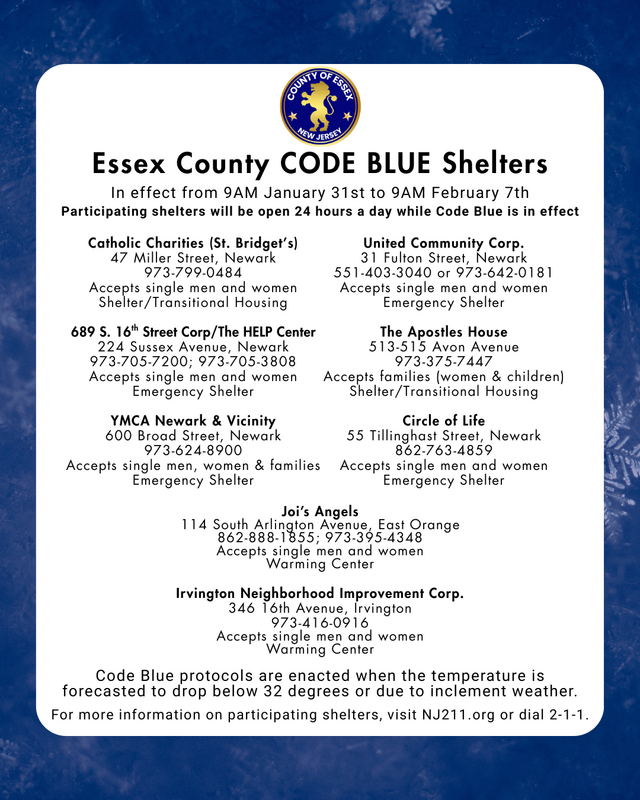
In Essex County, The Honorable Joseph N. DiVincenzo, Jr. and Sheriff Amir Jones announced an extension of Code Blue protections from Saturday, January 31 at 9 a.m. through Saturday, February 7 at 9 a.m., in response to the prolonged deep freeze.
With temperatures dipping below 32 degrees and wind chills far colder these protections are in place around the clock.
When Code Blue is declared, a coordinated network opens its doors: public libraries, senior centers, civic and community centers, school buildings, houses of worship, firehouses, and first aid squad buildings. 
Community-based organizations operate shelters, while county and municipal partners ensure warming stations are available with heat, food, and a safe place to rest.
Information on participating locations is available through NJ 211, a statewide resource connecting residents to help when they need it most.
According to guidance shared by NJ 211 and state partners, towns across New Jersey are doing their best—often under strain—to bring people in from the cold, conduct outreach, and connect residents without addresses to longer-term support.
It’s not framed as an “epidemic,” but as an ongoing issue that requires patience, coordination, and compassion—especially during stretches like the past week and a half, when below-zero wind chills made survival itself a daily hurdle.
The work isn’t easy, and it isn’t finished. But on nights/mornings like these, when doors open and lights stay on, it’s a reminder of who we are at our best.
Warmth, food, safety and respected can make the difference. And sometimes, it starts with recognizing a familiar face, offering a hot drink, and like Essex County officials, choosing to care.