
By: Staff
A newly issued independent legal and professional review concludes that the New Jersey Office of the State Comptroller (“OSC”) stepped outside the authority granted by the Legislature, failed to follow mandatory national investigative standards, and issued findings about the Township of Irvington’s opioid settlement spending in a manner that undermined due process and cannot be treated as reliable or entitled to deference.
According to the review, OSC’s July 8, 2025 Strategic Initiatives Unit report is not simply disputed on the merits.
It is described as structurally compromised by recurring statutory, procedural, and professional failures—defects that, individually and collectively, make the report an improper foundation for enforcement, reimbursement demands, or reputational penalties.
The review was prepared by Scott J. MacDougall, a former OSC senior official who served for several years as Director of Investigations and is now a partner at DeCotiis, FitzPatrick, Cole & Giblin, LLP. Drawing on institutional experience and legal analysis, Mr. MacDougall concludes the OSC report reflects ultra vires conduct, investigative deficiencies, and serious constitutional concerns.
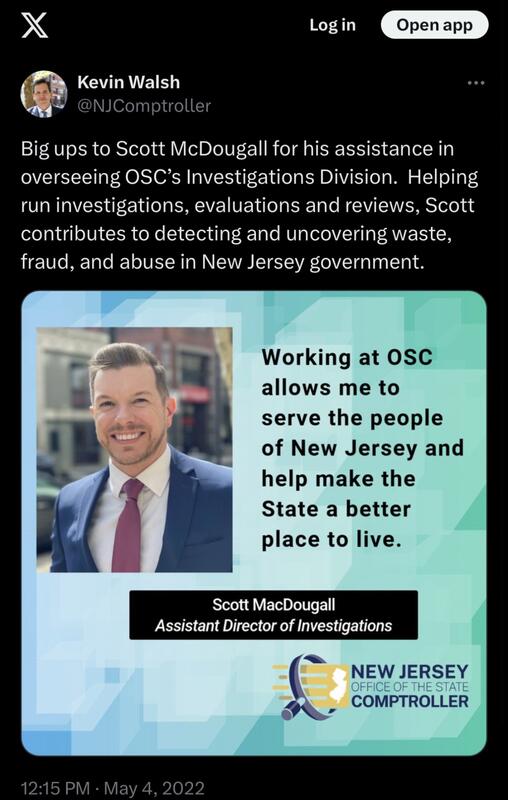
Mr. MacDougall’s investigative credentials were publicly recognized by OSC leadership while he served inside the agency. On May 4, 2022, then–Acting State Comptroller Kevin Walsh, posting from the official OSC platform, praised Mr. MacDougall’s role overseeing the Investigations Division, stating:
“Big ups to Scott MacDougall for his assistance in overseeing OSC’s Investigations Division. Helping run investigations, evaluations, and reviews, Scott contributes to detecting and uncovering waste, fraud, and abuse in New Jersey government.”

The review states that this contemporaneous recognition matters because it confirms that the assessment is grounded in investigative standards and judgment that OSC itself previously relied upon—and publicly endorsed.
Findings Summarized as Specific Violations
The review details a broad set of identified violations, each said to independently impair the report’s legality and credibility. In combination, the review characterizes the deficiencies as systemic, not accidental.
I. Statutory and Jurisdictional Overreach
1. Exceeding statutory limits on investigative authority
The review finds OSC operated beyond jurisdictional and functional limits imposed by the Legislature.
2. Taking over functions assigned to the Department of Human Services (DHS)
The review concludes OSC effectively displaced DHS by making determinations about “evidence-based” and “evidence-informed” spending—judgments the statute reserves to DHS.
3. Creating statewide standards without authorization
OSC is criticized for developing and applying its own definitions of key terms absent legislative permission and before DHS issued governing standards.
4. Ignoring statutory sequencing and coordination
The review states OSC issued compliance determinations before DHS and the Opioid Recovery and Remediation Advisory Council completed the statewide Strategic Plan.
5. Acting before the governing framework was finalized
The review maintains OSC reached definitive conclusions while the public-health framework intended to guide such evaluations was still developing.
6. Failing to apply the Extraordinary Use Spending (EUS) exception
The review alleges OSC did not analyze or apply the EUS exception that permits nontraditional, community-responsive opioid-abatement strategies.
7. Undermining statewide uniformity
By defining compliance on a case-by-case basis, OSC is said to have weakened the uniform statewide approach the Legislature intended.
II. Violations of Required National Investigative Standards
8. Not conducting the investigation under prevailing national standards
The review states OSC violated statutory requirements tied to nationally accepted inspector-general standards, including the AIG “Green Book.”
9. Running a conclusion-first investigation instead of neutral fact-finding
The investigation is described as outcome-driven rather than objective and evenhanded.
10. Minimizing or withholding exculpatory evidence
OSC is accused of discounting or omitting favorable information, including public-health participation, Narcan presence, outreach activity, and clinical engagement.
11. Shifting evidentiary rules midstream (“moving the goalposts”)
The review says OSC repeatedly raised evidentiary demands after Irvington produced responsive proof.
12. Treating missing paperwork as proof of wrongdoing
The review criticizes OSC for using documentation gaps as affirmative evidence of noncompliance, effectively reversing the burden of proof.
13. Disqualifying Rutgers clinical involvement using a made-up requirement
OSC is faulted for acknowledging clinical participation but discounting it because Rutgers did not “endorse” the funding—an endorsement required by no law or standard.
14. Turning subjective disagreements into alleged legal violations
The review states OSC substituted personal judgments (e.g., whether messaging was “meaningful”) for objective legal standards.
15. Using design and aesthetics as a compliance yardstick
OSC is criticized for attacking messaging and billboard design based on unstated preferences rather than legal or professional requirements.
16. Blurring fact, evaluation, and policy
The review alleges OSC failed to clearly separate factual findings from evaluative commentary and policy determinations.

III. Internal Contradictions and Unreliable Conclusions
17. Findings and remedies that do not match
The review highlights that OSC labeled expenditures “entirely wasted” while recommending reimbursement only for selected portions.
18. Using absolutist rhetoric inconsistent with acknowledged facts
The review objects to categorical language (“waste,” “misuse,” “no evidence”) even where OSC’s own report recounts facts pointing the other way.
19. Treating mixed records as total noncompliance
The review alleges OSC refused to recognize partial compliance or nuance, opting for sweeping condemnations.
20. Changing how compliance was characterized across audits
OSC is criticized for re-framing earlier partial implementation as noncompliance in later reports without explanation.
IV. Due-Process and Procedural-Fairness Failures
21. Converting an investigation into de facto adjudication
Although labeled investigative, the report is described as operating like an adjudication—declaring violations, demanding repayment, and recommending sanctions—without due-process safeguards.
22. Adding new evidence without giving Irvington a fair chance to respond
OSC is faulted for including post-draft testimony without allowing review and response.
23. Selectively quoting witnesses while omitting sworn clarifications
The review states OSC quoted officials in a way that created misleading impressions while ignoring clarifying certifications.
24. Leaving out Irvington’s request for technical help
The review states OSC omitted the Township’s request for technical assistance, removing key context demonstrating cooperation and good faith.
25. Making premature and inaccurate statements to the court
OSC is accused of asserting Irvington failed to participate before the response deadline had expired.
26. Releasing the report while judicial relief was pending
The review states OSC disseminated the report to State leadership despite an active request to stay publication.
27. Cumulative procedural unfairness
Taken together, these actions are said to have denied Irvington a fair and lawful process.
V. Failures in Oversight Responsibilities and Escalation
28. Not providing mandatory technical assistance despite an express request
The review states OSC ignored its statutory obligation to provide technical assistance even after Irvington formally requested it in good faith.
29. Escalating to condemnation instead of using corrective tools
The review argues OSC bypassed remedial oversight measures and proceeded directly to punitive public reporting.
30. Pursuing extraordinary oversight measures without justification
The review notes OSC sought severe remedies, including a fiscal monitor, even while the Township was cooperating and pursuing corrective action.

Why the Review Says This Matters
The review concludes that the OSC Irvington report reflects deep institutional and investigative breakdown, and therefore is not entitled to deference and should not serve as a platform for enforcement, reimbursement, or reputational punishment. The assessment further warns that the issues identified raise broader concerns about OSC’s adherence to statutory constraints, professional norms, and constitutional requirements.
Statements from Irvington Officials
Mayor Tony Vauss said:
“This isn’t about policy differences—it’s about legal limits and basic fairness. We cooperated, asked for guidance, and acted in good faith. The result was a report untethered from statute, standards, or due process.”
Township Attorney Ramon Rivera said:
“Legally, the defects identified here are profound. The report applied invented standards, ignored statutory exceptions, withheld mandated assistance, and imposed consequences without due process. That is the opposite of lawful oversight.”